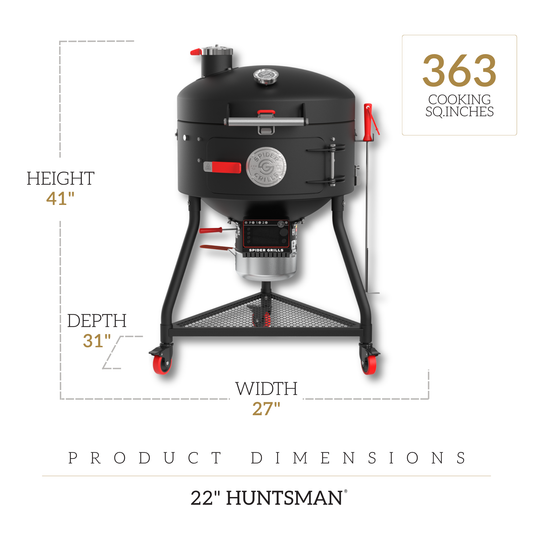
The Huntsman Cleaning Guide
A clean Huntsman cooks better, holds temp tighter, and lasts longer. The good news: it doesn't ask much of you. The Huntsman is built from 5mm carbon steel - the same material that makes pre-WWII cast-iron pans still usable today - so the maintenance routine is short, mostly hands-off, and entirely doable with what you already own.
Here's the full breakdown, from after-every-cook habits to the twice-a-year reset that keeps your Huntsman ready for the next decade.
First, the ground rules
Before you touch anything, two non-negotiables:
The grill must be completely cool. Carbon steel holds heat. A Huntsman that feels warm on the outside may still be over 200°F inside. Wait until it's cool through and through.
The Venom must be unplugged. No exceptions. You're working around an electronic controller - disconnect it from power before you start cleaning anything on or around the unit.
That's it. Those two rules apply to every step below.
After every cook: empty the ash bucket
This is the only step you should do every single time. The Venom catches ash in a small bucket mounted to the underside of the controller. If it overflows, you'll start seeing performance issues - uneven airflow, longer time to temp, harder relights.
Pop the ash bucket off, dump it into a sealed metal container, and reinstall. Takes 30 seconds.
A note on ash disposal that the manual is firm on, and worth repeating: ashes go in a metal container with a tight-fitting lid, placed on a non-combustible surface, well away from anything that can burn. Wait until every cinder is fully cold before you bury or otherwise get rid of them. Hot ash in the wrong bin is one of the most common backyard fire causes.
Every few cooks: clear the Venom's internal track
The Huntsman's airflow runs through a moving track inside the Venom. Ash can collect there over time, and when it does, the fan has to work harder to hit the temp you set. The result is a controller that's running hot to compensate - fine in the short term, hard on the system in the long term.
Once you've done five or six cooks, pop the Venom open and clear any ash that's settled in the track. Same goes for the inside of the grill itself: brush out any ash that's collected on the floor of the firebox. A small hand brush or shop vac handles both jobs in under a minute.
Every six months: re-season the inside
This is the big one, and it's the same process you ran at unboxing.
Carbon steel doesn't rust the way thinner materials do, but it isn't invincible. Over time, especially in humid climates, the seasoning layer on the inside surfaces breaks down. Once it does, you'll start seeing surface oxidation. Catch it early and the fix is simple. Wait too long and you're chasing rust.
The schedule from the manual: every six months, or anytime you notice rust or oxidation building up inside the grill - whichever comes first.
The process:
- Coat the inside surfaces with your seasoning kit (the same areas you treated at first startup - interior of the lid and base).
- Add lit charcoal.
- Run the Huntsman at 400°-500°F for one hour.
- Let it cool completely before the next cook.
That hour-long burn bonds the seasoning to the steel and resets your corrosion protection for another six months. It's also worth noting: Spider Grills' three-year warranty doesn't cover rust or oxidation, period. Re-seasoning is what keeps that from becoming your problem.
If you're out of seasoning kit, email [email protected] - we'll get you sorted.
Cleaning the outside
Everything outside the grill - the lid, the base, the legs, the Venom housing - gets the same treatment:
A lint-free cloth or rag, dampened with warm soapy water. Wipe down, dry off, done.
What you don't use on the outside is just as important: no oven cleaner, no abrasive cleaners, no scouring pads, no steel wool. Those will pull the finish off the powder coat and leave you with a grill that looks worse than the day you bought it. Soapy water handles 95% of what shows up on the outside of a Huntsman - soot, grease splatter, the occasional bird situation. Save the harsh stuff for something else.
Storing your Huntsman
Two things matter here.
Unplug it when you're not using it. This is both a safety and a longevity move - the controller is rated for outdoor use, but pulling power when the grill is dormant is the simplest insurance you can give it.
Use a cover if you store it outside. If your Huntsman lives on the patio in a part of the country that sees real rain, humidity, snow, or salt air, a grill cover keeps moisture off the steel between cooks. Indoor storage in a garage or covered shed is even better, but the cover gets you most of the way there if outside is your only option.
What not to do
A short list of things that will void your warranty or shorten the life of your Huntsman, all pulled directly from the manual:
- Don't run it over 700°F. The Huntsman is rated for high-heat cooking - searing, pizza, reverse-sear finishes - up to 700°F. Above that, warranty coverage stops and you risk damage to the gasket, finish, and internals.
- Don't use abrasive cleaners on the outside. Worth repeating.
- Don't hose down the Venom. It's an electronic controller. Wipe it with a damp cloth; don't drown it.
- Don't skip the re-season. It's 60 minutes, twice a year. That's the whole price of admission to a Huntsman that lasts.
The Huntsman is built to last - your job is letting it
A Huntsman that gets the ash emptied, the inside re-seasoned twice a year, and a wipe-down when it needs one will outlast almost everything else in your backyard. There's nothing complicated about the routine. It just needs to actually happen.
Five minutes after every cook. An hour every six months. That's the deal.
Questions about your Huntsman? Email us at [email protected] or check the full owner's manual at spidergrills.com.